Sunday, May 24, 2015


Introduction 

 What is Collaborative learning?


Collaborative learning is a situation in which two or more people learn or attempt to learn something together. Unlike individual learning, people engaged in collaborative learning capitalize on one another’s resources and skills (asking one another for information, evaluating one another’s ideas, monitoring one another’s work, etc.).More specifically, collaborative learning is based on the model that knowledge can be created within a population where members actively interact by sharing experiences and take on asymmetry roles. Put differently, collaborative learning refers to methodologies and environments in which learners engage in a common task where each individual depends on and is accountable to each other. These include both face-to-face conversations and computer discussions (online forums, chat rooms, etc.).Methods for examining collaborative learning processes include conversation analysis and statistical discourse analysis.

Example

  • Collaborative learning in a composition classroom can unite students when assigned open-tasks. Kenneth Bruffee introduced the learning method, Classroom Consensus Group, in which the instructor allocates groups of three to five (three being ideal) students and assigns a problem to be solved or question to be answered. There are two directions the nonfoundational task can be presented: as an indistinct, no right answer that generates discussion or propose an answer and request questions and a process of how the answer came to be. Once the task is assigned, the instructor backs off in order to resist the urge to intervene in students' conversation. The goal is to remove focus of the instructor's authority. The instructor must keep time to ensure the students are centered on analogizing, generalizing, and bridging their comprehension with others. Following group discussion, the instructor is to evaluate, not judge, the students' work. Ideas should be presented to the entire class thus allowing the small groups to come together as a whole. It is then that the answers can be compared, gaps can be filled, and authority is not on one individual.[19]


44 Benefits of Collaborative Learning


  1. Develops higher level thinking skills
  2. Promotes student-faculty interaction and familiarity
  3. Increases student retention
  4. Builds self esteem in students
  5. Enhances student satisfaction with the learning experience
  6. Promotes a positive attitude toward the subject matter
  7. Develops oral communication skills
  8. Develops social interaction skills
  9. Promotes positive race relations
  10. Creates an environment of active, involved, exploratory learning
  11. Uses a team approach to problem solving while maintaining individual accountability
  12. Encourages diversity understanding
  13. Encourages student responsibility for learning
  14. Involves students in developing curriculum and class procedures
  15. Students explore alternate problem solutions in a safe environment
  16. Stimulates critical thinking and helps students clarify ideas through discussion and debate
  17. Enhances self management skills
  18. Fits in well with the constructivist approach
  19. Establishs an atmosphere of cooperation and helping schoolwide
  20. Students develop responsibility for each other
  21. Builds more positive heterogeneous relationships
  22. Encourages alternate student assessment techniques
  23. Fosters and develops interpersonal relationships
  24. Modelling problem solving techniques by students' peers
  25. Students are taught how to criticize ideas, not people
  26. Sets high expectations for students and teachers
  27. Promotes higher achievement and class attendance .
  28. Students stay on task more and are less disruptive
  29. Greater ability of students to view situations from others' perspectives (development of empathy)
  30. Creates a stronger social support system
  31. Creates a more positive attitude toward teachers, principals and other school personnel by students and creates a more positive attitude by teachers toward their students
  32. Addresses learning style differences among students
  33. Promotes innovation in teaching and classroom techniques
  34. Classroom anxiety is significantly reduced
  35. Test anxiety is significantly reduced
  36. Classroom resembles real life social and employment situations
  37. Students practice modeling societal and work related roles
  38. CL is synergystic with writing across the curriculum
  39. CL activities can be used to personalize large lecture classes
  40. Skill building and practice can be enhanced and made less tedious through CL activities in and out of class.
  41. CL activities promote social and academic relationships well beyond the classroom and individual course
  42. CL processes create environments where students can practice building leadership skills.
  43. CL increases leadership skills of female students
  44. In colleges where students commute to school and do not remain on campus to participate in campus life activities, CL creates a community environment within the classroom


Collaborative Learning in Project Work


When students complete collaborative projects, they might create individual outcomes, collective outcomes, or both. Students could collaborate to learn new content or gain diverse perspectives, then describe their learning in a paper, project, or presentation. This can be described as an individual outcome of a collaborative process. Alternatively, students might collaborate and work together to produce one project, paper, or presentation that represents everyone’s work. This can be described as a collective outcome of a collaborative process. 


ghgh

Saturday, May 23, 2015

Human Information Cognitive Theory


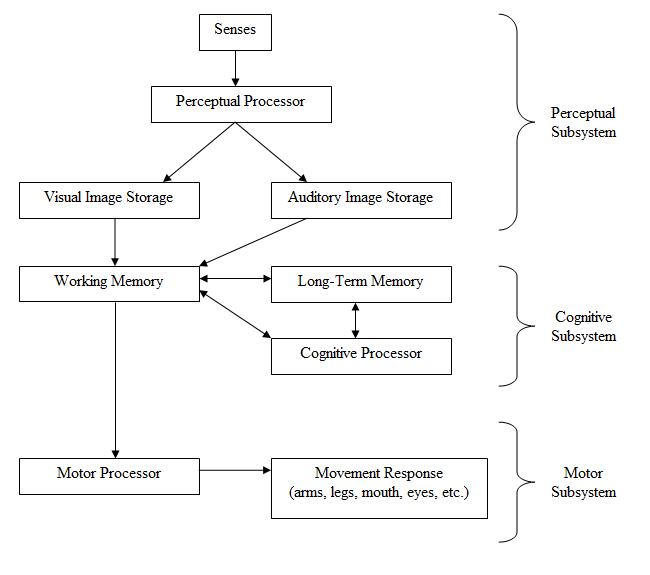
Image result for human information cognitive theory

                    Cognitive information processing (CIP) theory is often referred to as simply "information processing." Information processing is not really the name of a single theory; it is a generic name applied to various theoretical perspectives dealing with the sequence and execution of cognitive events. Schunk (1996) offers the following helpful summary/definition:
Information processing theories focus on how people:
              1. attend to environmental events,
                         2.  encode information to be learned and relate it to knowledge in memory,
                         3.  store new knowledge in memory, and
                         4.   retrieve it as needed.


Thus, learners are viewed as active seekers and processors of information.

CIP's Memory Model

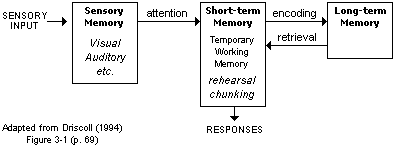
Figure 1: How Information Flows According to CIP Theory.
At the heart of CIP theory is its proposed memory system. This theory uses the computer metaphor with its inputs and outputs. CIP theory focuses on what happens in between input and output, i.e., oninformation processing. Get familiar with Figure 1 and think deeply about the flow of information it represents.
Pay attention not only to the basic components or memory stages:
  • sensory memory;
  • short-term memory (STM); and
  • long-term memory (LTM),
but also to the processes that keep information "alive" or help transfer it from one memory stage to the next:
  • attention;
  • rehearsal;
  • chunking;
  • encoding; and
  • retrieval.

CIP Definitions and Explanations


The Components of Memory


                    Figure 1 above displays the three basic components of CIP's proposed memory system—sensory memory, short-term memory (STM), and long-term memory (LTM)—along with the processes assumed to be responsible for transferring information from one stage to the next.

Brief descriptions of the three stages of memory follow:
  • Sensory memory holds information asso ciated with the senses (e.g., vision, hearing) just long enough for the information to be processed further (mere seconds).

  • STM functions as a temporary working memory, whereby further processing is carried out to make information ready for long-term storage or for a response. Working memory holds information for a limited amount of time and holds a limited amount of information.

  • LTM represents our permanent storehouse of information, capable of retaining an unlimited amount and variety of information.

The Flow of Information During Learning


                          Information is transformed or processed as it passes from one stage of memory to the next. However, processing doesn't really occur in the unidirectional, linear way implied by the diagram. For example, the mental representation one forms of a sentence s/he reads is determined both by the information itself (data-driven, bottom-up processing) and by one's prior knowledge (conceptually driven, top-down processing).
                        Additionally, in some way, an executive monitor keeps track of the information flow and makes decisions about processing priorities. This may occur in a conscious, strategic fashion or in an unconscious, automatic way.
Keep these two things in mind:
  • The computer provided a concrete metaphor for human information processing and, thus, a language for describing it.
  • For learning and instruction to be meaningful and relevant, it must build upon the learner's prior knowledge and help the learner to make connections between what they already know and what they are about to learn.

Selective Attention


                              Selective attention refers to the learner's ability to select and process certain information while simultaneously ignoring other information. Several factors influence attention:

  • The meaning that the task or information holds for the individual
  • Similarity between competing tasks or sources of information
  • Task complexity or difficulty (influenced also by prior knowledge)
  • Ability to control attention (which differs with age, hyperactivity, intelligence, and learning disabilities)

More About Short-Term Memory


                   Working memory is also known as STM or short-term memory. At this stage, concepts from LTM (long-term memory) will be activated for use in making sense of the incoming information.

                  STM has limited capacity: Seven bits of information (7 ± 2) have been shown to constitute the memory span for a great variety of materials. However, each bit of information can vary tremendously in size. Hence, working memory capacity may be increased through creating larger bits, the process known as chunking. Accordingly, learning tasks should be organized so that they can be easily chunked by the learner.

                 Unrehearsed information will be lost from working memory in about 15 to 30 seconds. To prevent the loss and ensure that information is transferred to LTM, two processes are necessary: rehearsal and encoding.

Rehearsal


                 Maintenance rehearsal refers to the repetition of information in order to maintain it in STM for some designated period of time. Maintenance rehearsal is not enough for complex or meaningful information to reach LTM. This can be accomplished through elaborative rehearsal, otherwise known as encoding.

Encoding


                    Encoding refers to the process of relating incoming information to concepts and ideas already in memory in such a way that the new material is more memorable. Various encoding schemes include:
  • Organization, e.g.:
    • grouping information into categories
    • outlines
    • hierarchies
    • concept trees
  • Mnemonics
  • Imagery
                        Nearly any method of elaborative encoding is better for learning than mere repetition of information. Which approach is best depends upon the learners and the material to be learned. Learners may be taught to develop and use their own strategies effectively, such as inventing their own mnemonics or utilizing self-questioning.

Retrieval of Information from Long-Term Memory


                         The process of retrieval from LTM involves bringing to mind previously learned information, to either (a) understand some new input or (b) make a response. Making a response may involve either recall or recognition.

Recall


                                 In free recall situations, learners must retrieve previously stored information with no cues or hints to help them remember. Cued recall tasks are those in which a hint or cue is provided to help learners remember the desired information.

Recognition


                                    Recognition involves a set of pregenerated stimuli (e.g., multiple-choice questions) presented to learners for a decision or judgment.

Retrieval Cues


                                     The process of retrieval can be greatly influenced by the cues available to learners at test time. For example, the encoding specificity principle states that whatever cues are used by a learner to facilitate encoding will also serve as the best retrieval cues at test time.


Problems

mouse-click-africa.jpg


  1. Lack of computers           
  2. Broken down computers 
  3. Fear by the administration 
  4. Fear by the teacher
  5. Lack of internet or slow connectivity
  6. Lack of initiative by the community leaders  


Disadvantages of Using ICT in Education


Students may become too reliant on computers and not learn other skills thoroughly enough. So for example, they may use the computer to do some mathematical activities rather than learning and understanding themselves. They may be able to get a good result, but not really know what it means. Students may not fully engage in research and experiments, but use search engines for resources. Manual research, like going into libraries, and talking directly to people is often better and helps students gain a better understanding of the information they are getting. 


Another important drawback to using ICT in schools is the fact that computers are expensive. As you know ICT items are very expensive and even after purchasing them they have maintenance problems. This may be seen as a good thing by my opponents but on the other hand there will be little money left over for other significant costs.
I.C.T technology has provided access to damaging information through various websites that host destructive and immoral content.
Viruses can come through the internet damaging the files in your processer
Advantages of using ICT in education

dvantages of I.C.T in education      
  Worldwide research has shown that ICT can lead to improved student learning and better 
teaching methods. A report made by the National Institute of Multimedia Education in Japan
, proved that an  increase in student exposure to educational ICT through curriculum integration
has a significant and positive impact on student achievement, especially in terms of "Knowledge
Comprehension" · "Practical skill"  and "Presentation skill" in subject areas such as mathematics
, science, and social study.
Since the rising of the information, educations have been changed in a lot of ways. Information age 
have made education easy
 3 Main advantages of ICT tools for education


01)Through ICT, images can easily be used in teaching and improving the   retentive memory of students

02)Through ICT, teachers can easily explain complex instructions and ensure students' comprehension
03) Through ICT, teachers are able to create interactive classes and make the lessons more enjoyable, which could improve student attendance and concentration.

ICT in Education

Key Benefits of ICT-based Education:

  • Promotes Learning by doing approach
  • Enables self-paced learning
  • Provides access to wide range of up-to-date learning materials
  • Enriches learning through a combination of audio, video, images, text and animation
  • Enhances learning through interaction and collaboration
  • Provides a platform that engages students
There is a common misconception that ICT-based Education is about teaching students computer skills. ICT-based Education is about using computers and technology as tools to enrich learning in various subjects such as English, science and mathematics.

Using ICT for Education


Information and Communication Technologies have recently gained groundswell of interest. It is a significant research area for many scholars around the globe.  Their nature has highly changed the face of education over the last few decades.
For most European countries, the use of ICT in education and training has become a priority during the last decade. However, very few have achieved progress. Indeed, a small percentage of schools in some countries achieved high levels of effective use of ICT to support and change the teaching and learning process in many subject areas. Others are still in the early phase of Information and Communication Technologies adoption.
Blanskat, Blamire, kefala (2006) conducted a study carried out in national, international, and European schools. With the aim to draw evidences regarding the advantages and benefits of ICT in schools achievements. It seeks to measure the impact of ICT on students’ outcomes. The study also tried to establish a link between the use of ICT and students’ results in exams. The findings are interesting: ICT has positive impact on students’ performances in primary schools particularly in English language and less in science.  Schools with higher level of e-maturity show a rapid increase in performances in scores compared to those with lower level. 
In addition, schools with sufficient ICT resources achieved better results than those that are not well-equipped.  There is a significant improvement on learners’ performances.  Finally, teachers become more convinced that educational achievements of pupils are due to good ICT use. In fact, high percentage of teachers in Europe (86%) states that pupils are more motivated when computers and Internet are being used in class.
Many pupils consider ICT tools very helpful in that it helps them to do assignments teachers see that ICT enables students with special needs or difficulties. It also helps to reduce the social disparities between pupils, since they work in teams in order to achieve a given task. Students also assume responsibilities when they use ICT to organize their work through digital portfolios or projects.  In addition, the study showed that ICT has significant impact on teachers and teaching processes.
By virtue of government Interventions and training seminars organized in this regard, ICT tools stimulate teachers. Indeed, an absolute majority of teachers in Europe (90 %) claim to use ICT to do tasks, such as preparing lessons, sequencing classroom activities, etc. Therefore, teachers plan their lessons more efficiently. ICT also help teachers to work in teams and share ideas related to schools curriculum. There is also evidence that broadband and interactive whiteboards play a central role in fostering teachers’ communication and increasing collaboration between educators. 
The ICT Test Bed evaluation (Underwood 2006) provides an evidence that many teachers use ICT to support innovative pedagogy. It states: “New technologies that provide a good fit with existing practices, such as interactive whiteboards are first to be embedded, but others like video conferencing, digital video and virtual learning environments are now being incorporated, providing evidence of ongoing learning by the workforce. Training needs to continue to support innovative pedagogy.” Both examples show that ICT is being integrated in a continuous process. Therefore, ICT can improve teaching by enhancing an already practiced knowledge and introducing new ways of teaching and learning. Transforming teaching is more difficult to achieve. “Changes that take full advantage of ICT will only happen slowly over time, and only if teachers continue to experiment with new approaches.” (Underwood 2006) This evaluation came from a teacher training seminar in IT during the ITMF project. It showed that teachers have not fully changed their use of ICT in education; however, most of them changed their way of thinking about the application of ICT in education. Teachers have increased their use of ICT in lessons where students look for information on the net and use it afterwards for subject specific areas, but hardly any use of ICT for class presentations. Nonetheless, teachers do not make use of ICT to engage students more actively to produce knowledge. Similarly, the e-learning Nordic study shows an increase in the use of ICT to teach but not to innovate teaching methods: “ICT generally has a positive impact on teaching and learning situations, but compared with the ideal expectations; the impact of ICT on teaching and learning must still be considered to be limited” (Ramboll, 2006).
Many teachers use ICT to support traditional learning methods, for example, information retrieval in which students are ‘passive learners of knowledge instead of ‘active producers able to take part in the learning process. In a document entitled teaching and learning with ICT, G. Galea (2002) explains how ICT can promote teaching and learning.  According to her there are two main reasons behind increasing the use of ICT in education in UK.  Firstly, ICT can change the lessons’ pace: she stated that children in modern society need to develop sufficient potentials and skills that enable them to take full advantage from the new opportunities that ICT offer.  Second, there are groundswells of interest of academic researches in UK in how technological tools can enhance the quality of teaching and learning in schools, and so help learners to achieve better outcomes.
Furthermore, it has been proved that new technologies have lots of benefits on the students.
ICT allow for a higher quality lessons through collaboration with teachers in planning and preparing resources (Ofsted, 2002). Students learn new skills: analytical, including improvements in reading comprehension (Lewin et al, 2000). ICT also develop some writing skills: spelling, grammar, punctuation, editing and re-drafting (Lewin et al, 2000). Still new technologies encourage independent and active learning, and students’ responsibility for their own learning (Passey, 1999) ICT proves that students who used educational technology felt more successful in school they are more motivated to learn more and have increased self- confidence and self-esteem. It is also confirmed that many students found learning in a technology-enhanced setting more stimulating and much better than in a traditional classroom environment (Pedretti and Mayer-Smith 1998).